Standard plastisol ink gets the job done for most screen-printed apparel. But when you want your custom prints to truly stand out — to catch the eye, invite a second look, or make someone reach out and touch your shirt — specialty inks open up a world of creative possibilities. From three-dimensional puff effects to mirror-like foil finishes, these techniques take custom apparel from ordinary to unforgettable.
Here is a deep dive into the most popular specialty screen printing inks, how they work, when to use them, and what to consider when designing with them.
Puff Ink: The 3D Texture Effect
Puff ink is a plastisol-based ink that contains a chemical additive which causes it to expand and rise off the fabric when heated during the curing process. The result is a raised, three-dimensional texture that adds a tactile element to your design. It is one of the most popular specialty finishes in custom screen printing.
How It Works
The ink is printed through a standard screen just like regular plastisol, but with a slightly heavier deposit. When the printed garment passes through the dryer or under a heat press, the puff additive activates and the ink expands, rising anywhere from 1/16 to 1/8 of an inch above the fabric surface. The higher the heat and the heavier the ink deposit, the more pronounced the puff effect.
When to Use Puff Ink
- Bold text and logos — Puff ink works best with solid, bold design elements. Block letters and chunky logos look fantastic with puff because the raised surface is immediately visible and touchable.
- Accent elements — Use puff selectively on specific parts of a design rather than the entire print. A puff outline around a logo or puffed lettering with flat-printed detail elements creates depth and visual interest.
- Streetwear and fashion brands — Puff ink is a staple of the streetwear aesthetic. It gives garments a premium, design-forward look.
- School and team gear — Puffed school names, mascot letters, and team numbers add a varsity, letterman-jacket quality to tees and hoodies.
Limitations
Puff ink does not reproduce fine detail well. Very thin lines, small text, and intricate patterns will not puff cleanly because the expansion distorts narrow shapes. Stick to elements that are at least 3 to 4 mm thick. The puff effect also adds weight to the print area, making very large puffed designs feel stiff. Use it strategically rather than covering the entire print area.
Foil Printing: Metallic Mirror Finish
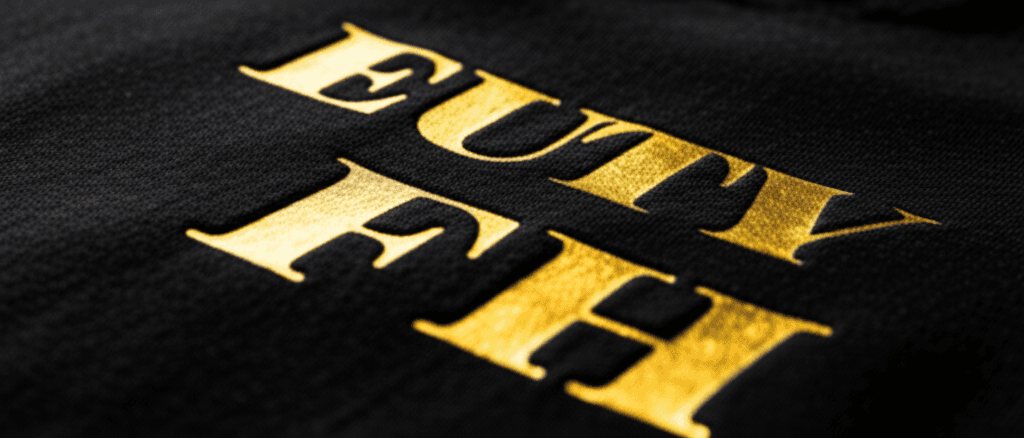
Foil printing produces a reflective, metallic finish that catches light and creates an eye-catching premium effect. Think of the shiny lettering on luxury packaging or the gold and silver accents on high-end fashion tees.
How It Works
Foil printing is a two-step process. First, an adhesive is screen printed onto the garment in the shape of your design. Then, a thin metallic foil sheet is placed over the adhesive area and heat-pressed. The foil bonds to the adhesive and is peeled away, leaving the metallic finish only where the adhesive was printed. The result is a smooth, mirror-like surface.
Available Foil Colors
Foil comes in a wide range of metallic finishes beyond standard gold and silver:
- Gold, silver, and copper
- Rose gold and champagne
- Holographic and iridescent
- Matte metallic finishes
- Colored metallic (blue, red, green, purple)
When to Use Foil
- Luxury and premium branding — Foil instantly communicates high-end quality. It is popular with fashion brands, event merchandise, and corporate gifts.
- Accent elements — A foil accent on a text block, a metallic icon within a larger print, or foil lettering layered over a standard ink print creates a sophisticated layered effect.
- Limited-edition drops — Foil makes a design feel exclusive and special. It is a natural choice for numbered runs and collector pieces.
Limitations
Foil is not as durable as standard plastisol ink when subjected to heavy washing. It can crack or peel over time, especially in high-friction areas. For best longevity, foil works best on garments that are worn and washed less aggressively — fashion pieces, event merch, and display garments. Foil also does not reproduce fine detail as cleanly as standard ink because the adhesive has a minimum coverage area for the foil to bond properly.
Metallic Inks: Shimmer Without the Mirror
If you want a metallic look but prefer the feel and durability of a standard screen print, metallic inks are the answer. These plastisol inks contain fine metallic particles that produce a shimmering, reflective quality without the mirror-like surface of foil.
How It Works
Metallic ink is printed exactly like standard plastisol — through a screen, cured in a dryer. The metallic particles embedded in the ink catch and reflect light, producing a subtle shimmer effect. Gold, silver, and copper are the most common metallic ink colors, though custom mixes are possible.
When to Use Metallic Ink
- Designs where durability matters — Metallic ink holds up significantly better through washing than foil. It is a safer choice for everyday wear.
- Large coverage areas — You can fill a large design area with metallic ink without the stiffness or durability concerns of foil.
- Subtle premium look — Metallic ink reads as premium and eye-catching without being as loud as full foil. It works well for corporate apparel, holiday-themed merch, and music/band merchandise.
Glow-in-the-Dark Ink
Glow-in-the-dark (phosphorescent) ink absorbs light energy and re-emits it as a visible glow when the lights go out. It is a fun, attention-grabbing specialty that works well for specific applications.
How It Works
The ink contains phosphorescent pigments that charge under natural or artificial light. Once in darkness, the stored energy is released as a greenish-white glow that fades over time (typically visible for 15 to 30 minutes in total darkness, brightest in the first few minutes). The ink is printed as a standard screen print, usually with a heavier deposit for a stronger glow.
When to Use Glow-in-the-Dark Ink
- Event and festival merchandise — Concerts, Halloween events, glow runs, and nightlife branding.
- Kids' apparel and novelty items — Youth camps, Halloween-themed designs, and fun promotional products.
- Safety and visibility accents — While not a replacement for certified retroreflective materials, glow accents add a functional visibility element to casual wear.
Limitations
The glow-in-the-dark pigment is white or off-white when uncharged and in normal lighting. This means the ink shows as a pale, slightly translucent layer on the garment during the day. It works best on lighter-colored garments where the daytime appearance is less noticeable, or as a layered element over a standard ink base.
Reflective Ink: Visibility That Pops
Reflective ink contains tiny glass microspheres that bounce light back toward its source — the same principle used in road signs and safety striping. When hit by direct light (headlights, camera flash, streetlights), the printed area lights up dramatically.
When to Use Reflective Ink
- Athletic and running gear — Safety-conscious runners and cyclists love reflective branding on their workout apparel.
- Streetwear with a functional edge — Reflective logos and design elements that appear when caught by flash photography are a popular streetwear trend.
- Safety-adjacent workwear — For garments that do not require ANSI-rated reflective striping but where enhanced visibility is a plus.
Limitations
Reflective ink has a gray, slightly rough appearance in normal lighting. The dramatic reflective effect only activates under direct light. It is not a flashy daytime effect — it reveals itself at night.
Combining Specialty Inks for Maximum Impact
The most creative custom prints combine multiple specialty techniques in a single design. Some proven combinations include:
- Puff ink lettering + flat metallic ink accents — The raised text draws the eye, and the metallic shimmer adds sophistication.
- Standard ink base + foil overlay — Print a full-color design first, then add foil accents over specific elements for a layered, premium effect.
- Puff ink + glow-in-the-dark — Raised elements that glow in the dark. Popular for streetwear and event merch.
- Reflective ink accent + standard print — A clean standard print by day with a reflective logo that lights up at night.
Design Tips for Specialty Inks
- Keep it bold. Most specialty inks work best with thick lines, large text, and solid shapes. Fine detail gets lost in the texture.
- Use specialty as an accent. A full design in puff ink or foil can look overwhelming and feel heavy. Strategic accents are more effective.
- Discuss with your printer early. Not every shop offers every specialty ink. Bring your creative ideas to your decorator during the design phase so they can advise on feasibility and cost.
- Order samples. Specialty finishes are difficult to visualize from a digital mockup alone. A physical sample tells the real story.
- Consider the garment. Dark garments showcase metallic, foil, and reflective inks dramatically. Glow-in-the-dark reads better on lighter garments.
Bring Your Vision to Life
At French Press Custom, we offer the full range of specialty screen printing inks — puff, foil, metallic, glow-in-the-dark, reflective, and more. Our production team has the experience to combine techniques, advise on design feasibility, and produce specialty prints that look as good in person as they do in your imagination.
Want to explore specialty inks for your next project? Get a free quote from French Press Custom or call us at (562) 407-3800.
Related service: We print puff, foil and other specialty inks in-house. Get a free quote.
Frequently Asked Questions
How does puff ink create a raised print?
Puff is plastisol with a chemical additive that expands when heated during curing. Printed with a slightly heavier deposit, it rises roughly a sixteenth to an eighth of an inch above the fabric, and more heat with a heavier deposit produces a more pronounced effect.
How durable is foil printing compared to regular ink?
Foil is not as durable as standard plastisol under heavy washing and can crack or peel over time, especially in high-friction areas. It is best suited to fashion pieces, event merch and display garments rather than gear that gets laundered hard.
What is the difference between foil and metallic ink?
Foil is a two-step process where adhesive is screen printed, then a metallic sheet is heat-pressed onto it for a mirror-like surface. Metallic ink is a plastisol carrying fine metallic particles that shimmers rather than mirrors, and it holds up significantly better through washing.
Do specialty inks reproduce fine detail?
Generally no. Puff, foil and most specialty finishes need bold lines, large text and solid shapes, because the texture or the minimum adhesive coverage swallows thin elements. Keep puff elements at least three to four millimeters thick and treat specialty finishes as accents rather than the whole design.