If you are planning a custom apparel project, two of the most popular decoration methods you will encounter are screen printing and DTF (direct-to-film) printing. Both produce professional results, but they work in fundamentally different ways and excel in different situations.
This guide breaks down the key differences between screen printing and DTF so you can make a confident decision for your next order.
What Is Screen Printing?
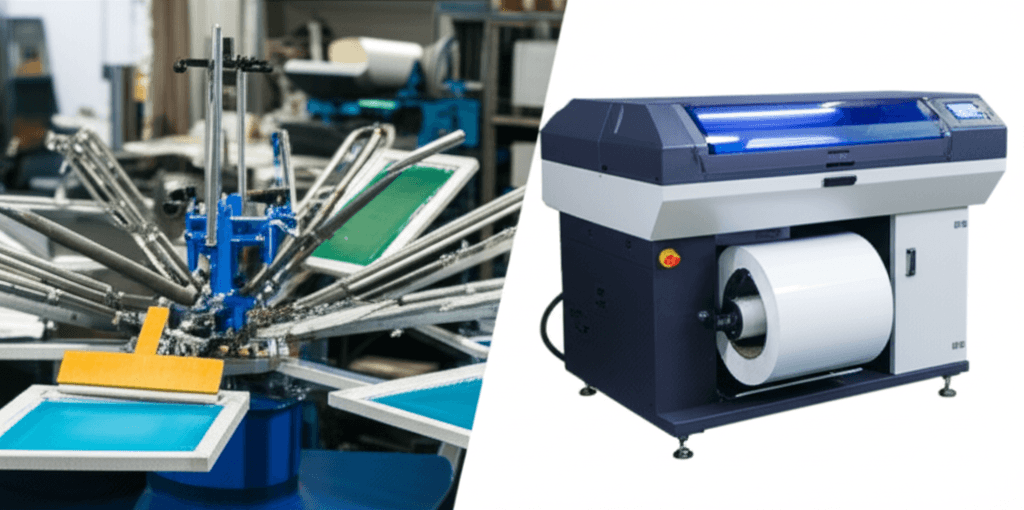
Screen printing is the traditional workhorse of the custom apparel industry. The process involves creating a stencil (called a screen) for each color in your design, then pressing ink through the mesh screen directly onto the fabric.
Each color in the design requires its own separate screen, which is why screen printing is often described as a per-color process. The ink sits on top of the fabric and is cured with heat to create a durable, vibrant finish.
Key characteristics of screen printing:
- One screen per color in the design
- Ink types include plastisol, water-based, and discharge
- Best suited for bold graphics with limited color counts
- Setup costs are higher, but per-unit cost drops significantly at volume
- Extremely durable prints that withstand hundreds of washes
What Is DTF Printing?
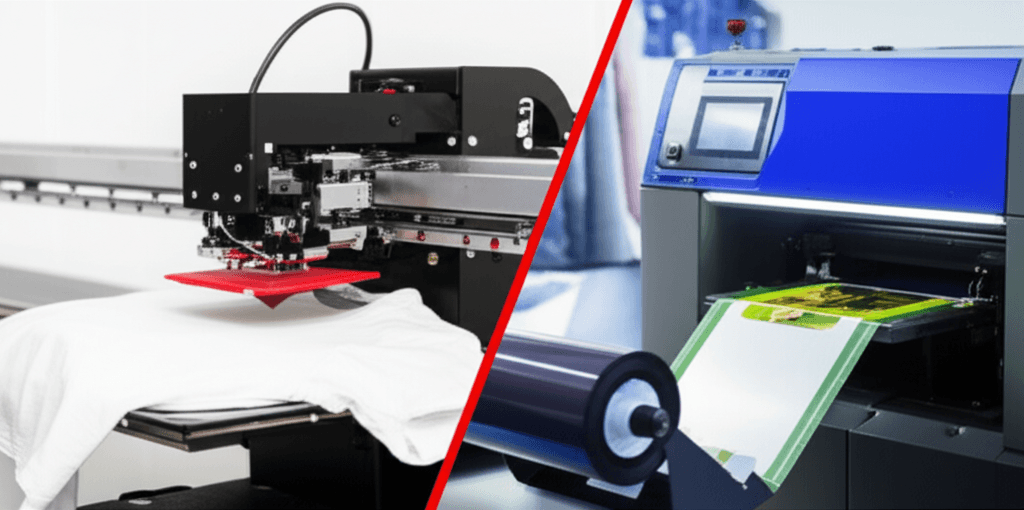
DTF (direct-to-film) printing is a newer digital method that has rapidly gained popularity. The process involves printing a full-color design onto a special PET film using CMYK and white inks, applying a hot-melt adhesive powder, and then heat-pressing the transfer onto the garment.
Because DTF is a digital process, there are no screens to create and no color limitations.
Key characteristics of DTF printing:
- Full-color printing with no per-color cost increase
- Works on virtually any fabric type and color
- Low 12-piece minimum at French Press Custom
- Prints have a slightly thicker hand feel compared to water-based screen prints
- Excellent detail reproduction for photographs and complex gradients
Side-by-Side Comparison
Cost Structure
Screen printing has a higher upfront cost because every color needs its own screen. At French Press Custom that prep is built into the per-piece price at every quantity, starting at our 36-piece-per-design minimum; the current figures are in our screen printing cost guide. Once the screens are made, the per-unit cost is extremely low, especially at quantities above 72 pieces.
DTF printing has only a small one-time setup per print location. You pay per transfer, which makes it highly cost-effective for small orders of 12 to 48 pieces. Per-transfer pricing does step down at 50, 100, and 250 pieces (see the DTF cost guide), but the curve is flatter than screen printing, so it does not benefit from volume the same way.
The crossover point: For most designs, screen printing becomes more cost-effective than DTF somewhere around 48 to 72 units. Below that, DTF usually wins on price.
Print Quality and Detail
Screen printing delivers unmatched vibrancy on simple designs. Spot colors are mixed to exact Pantone specifications, producing rich, saturated results. However, photographic images and designs with many colors require simulated process printing, which adds complexity and cost.
DTF excels at reproducing fine detail, photographic images, and designs with unlimited colors. Gradients, skin tones, and intricate illustrations look sharp and accurate without any additional setup.
Durability
Screen printing, particularly with plastisol ink, is legendary for durability. A well-cured screen print can survive 100+ wash cycles with minimal fading or cracking. Water-based and discharge prints offer an even softer hand feel while maintaining excellent longevity.
DTF transfers are durable and hold up well through regular washing, but they generally do not match the longevity of a cured plastisol screen print. Over time, DTF prints may show slight cracking at stress points. That said, modern DTF technology has closed this gap significantly.
Hand Feel
Screen printing offers the widest range of hand feels. Water-based inks soak into the fabric for an almost invisible feel, while plastisol sits on top with a smooth, slightly raised texture. Specialty inks like puff, metallic, and glow-in-the-dark add tactile dimension.
DTF prints have a consistent feel regardless of the design, which is slightly thicker and more plasticky than a water-based screen print. The feel is comparable to a plastisol print and most customers find it comfortable.
Fabric Compatibility
Screen printing works best on cotton and cotton-blend fabrics. Printing on 100% polyester requires special inks and techniques to prevent dye migration.
DTF transfers adhere well to cotton, polyester, blends, nylon, and even some non-textile surfaces. This makes DTF the more versatile option when working with performance fabrics or mixed material orders.
When to Choose Screen Printing
- Large orders (72+ pieces): The per-unit cost advantage is significant
- Simple designs with 1 to 4 colors: Screen printing is unbeatable for bold, clean graphics
- Maximum durability: Workwear, uniforms, and items that get heavy use
- Exact color matching: When Pantone accuracy is critical for branding
- Specialty effects: Puff ink, metallic, glow-in-the-dark, and foil are screen-print-only techniques
- Repeat orders: We keep your artwork on file, so reorders are quick, and a reorder of the same design carries no setup cost
When to Choose DTF
- Small orders (12 to 48 pieces): No screens to burn keeps small runs affordable (under 12 pieces, DTG has no minimum)
- Full-color or photographic designs: Unlimited colors at no extra cost
- Quick turnaround: No screen creation means faster production
- Polyester and performance fabrics: DTF handles synthetic materials without issue
- Mixed sizes and designs: Each piece can be different without additional cost
- Sampling and prototypes: Perfect for testing designs before committing to a full run
Can You Combine Both Methods?
Absolutely. Many of our clients use DTF for initial samples or small promotional runs, then switch to screen printing once they have a proven design and need volume production. This hybrid approach gives you flexibility without sacrificing quality or budget.
Making the Right Choice
The best method depends on your specific project requirements. Ask yourself these questions:
- How many pieces do I need?
- How many colors are in my design?
- What fabric am I printing on?
- How important is wash durability?
- Do I need specialty effects?
- What is my timeline?
If you are still unsure, that is completely normal. The team at French Press Custom in Santa Fe Springs, CA works with both methods daily and can recommend the best approach for your project. We offer screen printing, DTF, and four other decoration methods, so our advice is always based on what is best for your design, not what is easiest for us.
Ready to get started? Request a free quote or call us at (562) 407-3800. We will help you pick the right method and get your project done right. Learn more about our screen printing and DTF transfer services.