
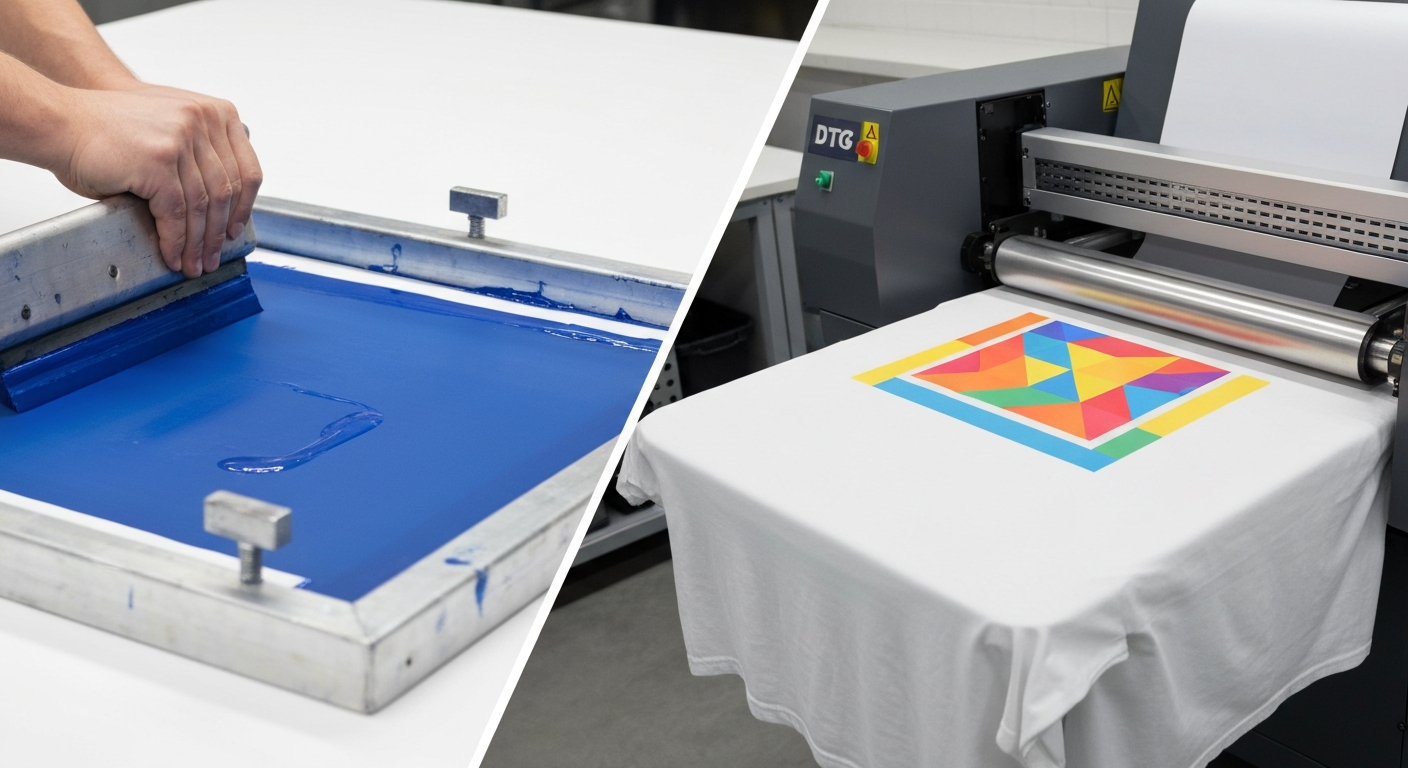
Screen Printing vs DTG Printing
Choosing between screen printing and direct-to-garment (DTG) printing? The right method depends on your order size, design complexity, budget, and timeline. This guide breaks down everything you need to know so you can make the best decision for your custom apparel project.
Trusted by the world’s best brands










At a Glance
Screen Printing vs DTG: Quick Comparison
Here is how the two most popular t-shirt printing methods stack up across the factors that matter most.
| Screen Printing | DTG Printing | |
|---|---|---|
| Minimum Order | 24 pieces | No minimum (1+) |
| Max Colors | Up to 8 (per screen) | Unlimited (full color) |
| Best For | Bulk orders, simple designs | Small runs, photo-realistic art |
| Durability | Excellent (50+ washes) | Very good (30-50 washes) |
| Fabric Compatibility | Most fabrics | Cotton & cotton blends only |
| Setup Fee | Included in per-piece price | None |
| Print Feel | Smooth, slight texture on fabric | Soft, ink absorbed into fabric |
Best Scenarios
When to Choose Screen Printing
Screen printing is the gold standard for bulk custom apparel. Choose it when:
Best Scenarios
When to Choose DTG Printing
DTG excels at full-color, low-quantity, and detail-heavy projects. Choose it when:
Cost Breakdown
Cost Comparison by Quantity
The per-unit cost of each method changes dramatically with order size. Here is where the crossover happens.
1-23 pieces
DTG wins
No setup fees make DTG the clear choice for small runs.
24-50 pieces
Crossover zone
Both methods are competitive. Decision depends on colors and complexity.
50+ pieces
Screen printing wins
Per-unit cost drops fast. At 200+, screen printing is 40-60% cheaper.
Not sure about your quantity?
Our estimate tool calculates exact pricing for both methods so you can compare side by side.
Try the Quote CalculatorQuality & Feel
Durability, Feel, and Vibrancy
Both methods produce professional results, but they differ in how the ink bonds with the fabric.
Screen Printing Quality
- Durability: Ink cures at 320F, creating a plastic bond that withstands 50+ washes
- Vibrancy: Opaque inks pop on dark fabrics. PMS color matching available
- Feel: Slight texture on fabric. Discharge inks available for a softer hand
- Best finish: Bold, vibrant, consistent across hundreds of pieces
DTG Quality
- Durability: Water-based ink bonds with cotton fibers. Lasts 30-50 washes
- Vibrancy: Excellent on light fabrics. Can print on dark with white underbase
- Feel: Virtually no texture. Ink is absorbed into fibers for a soft hand
- Best finish: Photo-realistic detail, soft feel, retail-quality prints
Common Questions
Screen Printing vs DTG FAQ
Answers to the questions we hear most when customers are deciding between screen printing and DTG.
Which lasts longer, screen printing or DTG?
Is DTG cheaper than screen printing?
Can you screen print a photograph on a shirt?
Does DTG work on polyester?
How many colors can I use with screen printing?
Which method has a softer feel on the shirt?
Can I mix screen printing and DTG in the same order?
What is the turnaround time for each method?
Not Sure Which Method to Choose? We Will Help.
Tell us about your project and our team will recommend the best printing method, garment, and pricing for your exact needs. Free quotes, no obligation.