
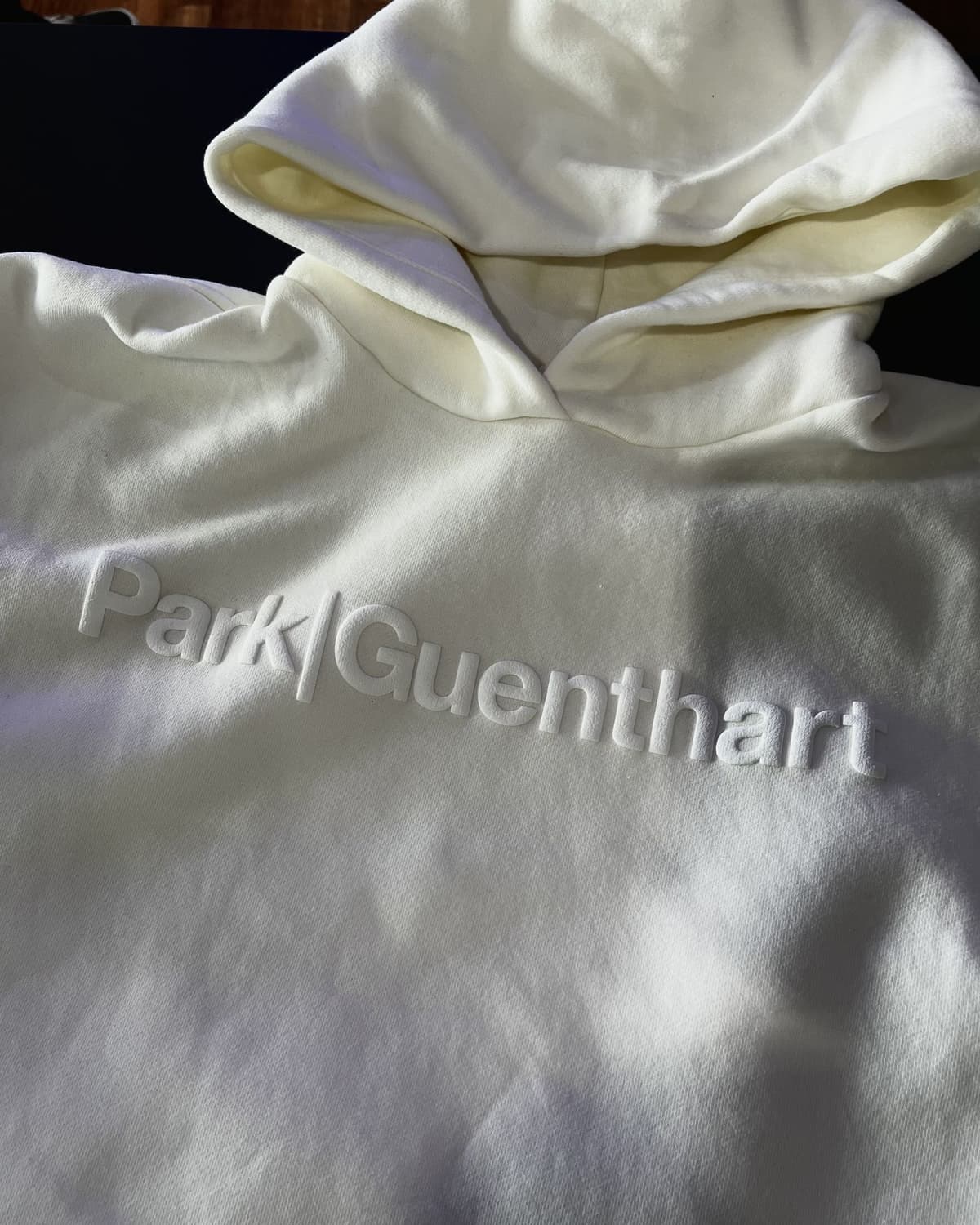
Fleece hoodies have a brushed, fuzzy inside and are warmer; French terry hoodies keep the inside loops unbrushed, so they are lighter and breathe better. The hoodies compared here run 7.4 to 11.8 oz per square yard. At French Press Custom in Santa Fe Springs, a one-color front on 50 black Gildan 18500 fleece hoodies is $29.47 each.
Prices below come from the engine behind our instant quote calculator, using live supplier blank prices. They are per hoodie, before tax, sizes S to XL, with screen setup included.
Fleece vs French terry: what is the difference?
Both fabrics start the same way: a smooth knit face on the outside and yarn loops on the inside. The difference is what happens to those loops.
| Fleece | French terry | |
|---|---|---|
| Inside | Loops brushed into a soft, fuzzy nap | Loops left as small, flat loops |
| Warmth | Warmer, traps more air | Lighter, breathes better |
| Weights of the examples below | 8 to 11.8 oz/yd² | 7.4 to 9.4 oz/yd² |
| Feel | Plush and cozy | Smooth, athletic, drapes more |
| Best for | Cold mornings, winter merch, school and team hoodies | Southern California layering, gyms, spring and fall |
| Outside print surface | Smooth knit face | Smooth knit face |
You will also see 3-end fleece in spec sheets. It means the fabric is knit from three yarns, which lets the mill put one yarn on the face, often 100% cotton, and a different yarn on the inside loops. Loopback terry is another name for French terry.
Live price
What will my order cost?
Method
Quantity
Ink colors
Garment
Examples of each in our catalog
Specs are from each brand's product description in our supplier catalog, except the AS Colour 5146 (AS Colour product API) and the Stanley/Stella Cruiser 2.0 (Stanley/Stella product API). Gram figures in brackets are converted from ounces where the brand did not list them.
| Hoodie | Fabric type | Weight | Blend | Face |
|---|---|---|---|---|
| Lane Seven LS13001 | 3-end French terry | 7.4 oz (about 251 g/m²) | 80/20 cotton/recycled poly | 100% cotton face |
| Independent PRM90HT | French terry, pre-laundered | 7.5 oz (about 254 g/m²) | 70/30 cotton/poly (black is 55/45) | Not stated |
| Independent SS1000 | Loopback terry | 7.5 oz (about 254 g/m²) | 55/45 cotton/poly | Not stated |
| American Apparel FT498 | French terry | 9.4 oz (about 319 g/m²) | 85/15 cotton/poly | 100% cotton face |
| Gildan 18500 Heavy Blend | Fleece | 8 oz (about 271 g/m²) | 50/50 cotton/poly | Finer face yarn, "helps reduce pilling" |
| Hanes P170 EcoSmart | Fleece | 8 oz (about 271 g/m²) | 50/50 cotton/poly | Low-pill PrintPro XP fabric |
| BELLA+CANVAS 3719 | Sponge fleece | 8 oz (about 271 g/m²) | 52/48 cotton/poly | 100% cotton face |
| Independent SS4500 | Fleece | 8.5 oz (about 288 g/m²) | 80/20 cotton/poly | 100% cotton face |
| Independent IND4000 | 3-end fleece | 10 oz (about 339 g/m²) | 70/30 cotton/poly | 100% cotton face |
| Stanley/Stella Cruiser 2.0 | 3-end brushed fleece | 10.3 oz (349 g/m²) | 80/20 organic cotton/recycled poly | 100% organic cotton face |
| Champion S101 Reverse Weave | Fleece | 11.5 oz (about 390 g/m²) | 82/18 cotton/poly | Not stated |
| AS Colour 5146 Heavy Hood | Fleece | 11.8 oz (400 GSM) | 80/20 cotton/recycled poly | Cotton facing |
Heather, camo and safety colors are often a different blend from the solids, so check the exact color.
What do hoodie weights mean?
Fabric weight is listed in ounces per square yard (oz/yd²) in the US or grams per square meter (GSM) elsewhere. One oz/yd² is about 33.9 GSM.
| Weight band | oz/yd² | About GSM | How it wears | Examples |
|---|---|---|---|---|
| Light | Under 8 | Under 270 | A layer, not a jacket | LS13001, PRM90HT, SS1000 |
| Mid | 8 to 9.5 | 270 to 320 | The everyday hoodie | 18500, P170, 3719, SS4500, FT498 |
| Heavy | 10 and up | 340 and up | Warm, structured, premium feel | IND4000, Cruiser 2.0, S101, AS Colour 5146 |
Heavier is not always better: a mid-weight 8 oz hoodie is easier to wear through a Southern California winter and costs less to print.
Cotton/poly blends: 50/50 vs 80/20 vs 100% cotton face
- 50/50 cotton/poly (Gildan 18500, Hanes P170). Holds its shape, resists shrinking, and keeps the price down. Standard plastisol screen printing and embroidery work well.
- 80/20 or 70/30 with a 100% cotton face (SS4500, IND4000, Cruiser 2.0, LS13001). Softer outside, and the cotton face gives a smoother surface for cotton-friendly printing.
- Mostly cotton (Champion S101 at 82/18, FT498 at 85/15). The softest hand and the most natural feel.
The polyester share matters most for soft-hand prints. Discharge printing needs 100% cotton with dischargeable dye, and polyester and most blends do not discharge, so a discharge hoodie print is a special case to discuss with us before you choose the blank. See water-based and discharge printing.
Do hoodies pill, and which ones pill less?
Pilling is the small fuzz balls that form where fabric rubs, such as the sides and cuffs. Blends with polyester are where most people notice it. Brands address it in the fabric itself: Gildan says the 18500's finer face yarn helps reduce pilling, and Hanes describes the P170's PrintPro XP fabric as low-pill and high stitch density.
To keep pilling down, wash inside out on cold with similar fabrics (not towels or jeans), tumble dry low or hang dry, and skip bleach; Stanley/Stella's care data, for example, says no bleach and tumble dry low.
Do hoodies shrink?
Cotton-heavy fleece can shrink in length after hot washing and drying. Some brands build against it: Champion says the S101 Reverse Weave is engineered to reduce vertical shrinking, and Independent cuts its IND5000P body and hood cross-grain to limit shrinkage and shortening after washing. Our Stanley/Stella hoodie comparison lists measurements size by size if fit is critical.
How fabric changes the print
- Screen printing works on all of these. On dark hoodies we print a white underbase under your ink so the color stays bright, and the quote includes that extra screen automatically.
- DTG prints best on 100% cotton, so a hoodie with a 100% cotton face is the better canvas. DTF does not depend on fiber mix, so it handles full color on any blend.
- Embroidery is at home on fleece. A heavier fleece holds a dense logo without puckering as much as a thin knit. See embroidery.
- Puff ink gives a raised print on a hoodie front. See specialty inks.
What does a printed hoodie cost by fabric?
Black hoodie, size L (S to XL are the same price). Screen printing starts at 36 pieces per design and embroidery at 24. Embroidery is a left-chest logo up to 5,000 stitches, plus a one-time $45 digitizing fee not included below.
| Hoodie | Fabric | 1-color front screen print, 50 pcs | Embroidered left chest, 50 pcs |
|---|---|---|---|
| Lane Seven LS13001 | French terry, 7.4 oz | $27.56 | $28.97 |
| Gildan 18500 | Fleece, 8 oz | $29.47 | $30.88 |
| Hanes P170 | Fleece, 8 oz | $29.47 | $30.88 |
| Independent SS4500 | Fleece, 8.5 oz | $30.13 | $31.54 |
| Independent SS1000 | Loopback terry, 7.5 oz | $31.83 | $33.24 |
| BELLA+CANVAS 3719 | Sponge fleece, 8 oz | $38.18 | $39.59 |
| Independent IND4000 | Fleece, 10 oz | $40.26 | $41.67 |
| Independent PRM90HT | French terry, 7.5 oz | $44.78 | $46.19 |
| American Apparel FT498 | French terry, 9.4 oz | $45.13 | $46.54 |
| Stanley/Stella Cruiser 2.0 | Fleece, 10.3 oz | $47.09 | $48.50 |
| AS Colour 5146 | Fleece, 11.8 oz | $50.22 | $51.63 |
| Champion S101 | Fleece, 11.5 oz | $68.58 | $69.99 |
Sizes 2XL and up carry a supplier upcharge on most hoodies. At 50 pieces, a 2XL Gildan 18500 is $34.83 against $29.47 in L, while a 2XL Lane Seven LS13001 is $28.87. Fabric type alone does not set the price: the lowest price here is a French terry, and so are two of the hoodies above $44.
Our take
For most group orders we start with a mid-weight fleece like the Gildan 18500 or Independent SS4500, which balance warmth, durability and cost, and we compared those two in best hoodie blanks for printing. French terry is the pick when people will wear the hoodie indoors or year round in Southern California. A shop-floor tip for any fabric: plan a full front design to sit above the kangaroo pocket, because the pocket seams interrupt the print area. Every order gets a free digital proof, and production starts only after you approve it.
Ordering from Los Angeles or Orange County
- Where we are. 14130 Rosecrans Ave, Santa Fe Springs, CA 90670, serving Los Angeles and Orange County.
- Minimums. DTG none, DTF 12, embroidery 24, screen printing 36 pieces per design.
- Timing. About 2-3 weeks after art approval. Rush available depending on the schedule. Tell us your date.
- Contact. Mon-Fri 8am-4pm PT, (562) 407-3800, sales@frenchpresscustom.com.
Frequently asked questions
Is fleece or French terry better for a hoodie?
Fleece is warmer because its inside loops are brushed into a soft nap; French terry keeps the loops flat, so it is lighter and breathes better. For winter merch choose fleece, and for year-round Southern California wear French terry works well.
What GSM is a good hoodie?
Everyday mid-weight hoodies are about 270 to 320 GSM (8 to 9.5 oz/yd²). Heavyweight hoodies start around 340 GSM (10 oz), such as the 10 oz Independent IND4000 or the 400 GSM AS Colour 5146.
Do 50/50 hoodies pill?
They can, because polyester fibers ball up on the surface where the fabric rubs. Gildan says the 50/50 18500 uses a finer face yarn that helps reduce pilling, and washing inside out on cold with similar fabrics helps.
Which hoodie fabric is best for screen printing?
All common hoodie fabrics screen print well. A 100% cotton face gives the smoothest surface for detail and is needed for DTG and discharge; a 50/50 like the Gildan 18500 is the lowest-cost choice for standard plastisol, at $29.47 for 50 black hoodies with a one-color front.
What does 3-end fleece mean?
It means the fleece is knit from three yarns, which lets the mill use one yarn on the outside face, often 100% cotton, and another on the brushed inside. The Independent IND4000 and Stanley/Stella Cruiser 2.0 are both 3-end fleece.
How much do custom hoodies cost?
At French Press Custom, 50 black hoodies with a one-color front print range from $27.56 to $68.58 each before tax, depending on the blank. Embroidered left-chest logos range from $28.97 to $69.99 each, plus a one-time $45 digitizing fee.