The right print method comes down to four questions: how many pieces, how many colors, what fabric, and how you want the print to feel. At French Press Custom we run five methods under one roof in Santa Fe Springs: screen printing, DTG, DTF transfers, embroidery, and heat transfer vinyl. For most orders, one of them is clearly the best fit once you answer those four questions honestly.
This guide walks through each method the way we explain it at the counter, then gives you a side-by-side table and a set of quick picks for common jobs. (We do not offer sublimation, so it is not on the list.)
What are the five methods, in plain terms?
Screen printing
Ink is pushed through a fine mesh screen onto the shirt, one screen per color. It is the classic method for a reason: bright, opaque color, a durable cured ink layer, and the lowest per-piece price on larger runs. Our shop runs automatic presses (an 18-color Challenger II carousel, a 12-color M&R oversize press and two M&R Sportsman EX carousels) plus a manual press for specialty work. Setup is built into the per-piece price, and the minimum is 36 pieces per design. See screen printing.
DTG (direct-to-garment)
A wide-format textile printer jets water-based ink straight into the fabric, like a photo printer built for shirts. We run two Epson F2270 printers with an automated pretreat sprayer for dark garments. No screens, no setup, no minimum, and full color costs the same as one color. Best on cotton. See DTG printing.
DTF transfers
The design is printed onto film, coated with an adhesive powder, cured, then heat pressed onto the garment. DTF gives you full color like DTG, but it sticks to almost any fabric: polyester, nylon, blends, canvas. DTF starts at 12 pieces, with a small setup per print location. See DTF transfers.
Embroidery
Your logo is digitized into a stitch file and sewn into the garment on a commercial multi-head machine. It reads premium, survives just about anything, and is the standard for polos, jackets, and hats. Embroidery starts at 24 pieces, with a one-time digitizing fee for a new logo. See embroidery.
Heat transfer vinyl (HTV)
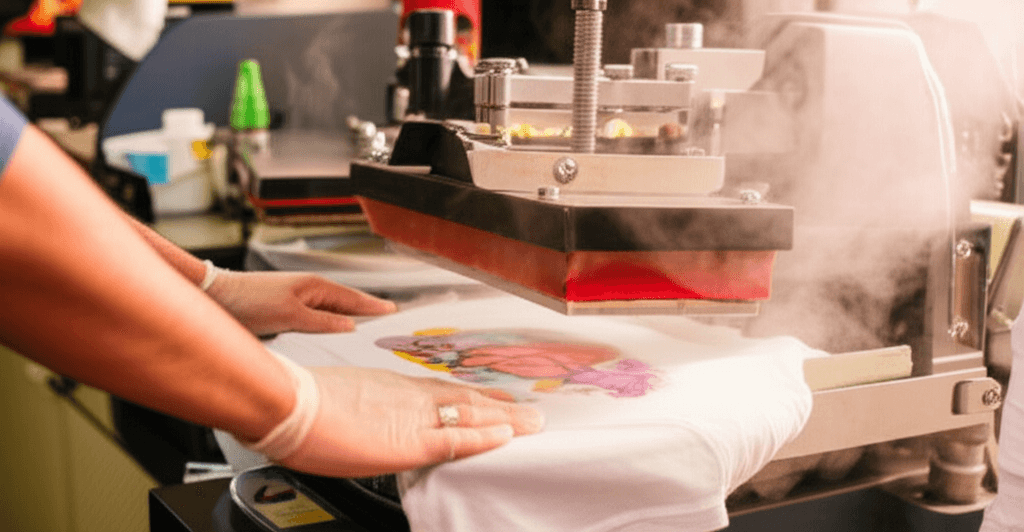
Shapes and letters are cut from colored vinyl on a plotter, weeded by hand, and heat pressed. Crisp edges, specialty finishes (glitter, reflective, metallic vinyl), and the easiest way to put a different name or number on every piece. Vinyl starts at 6 pieces. See heat transfer vinyl.
How do the five methods compare side by side?
| Factor | Screen print | DTG | DTF | Embroidery | HTV |
|---|---|---|---|---|---|
| Minimum | 36 per design | None | 12 | 24 | 6 |
| Best quantity | Larger runs | 1 to small runs | Small to mid runs | Any run past the minimum | Small runs, personalization |
| Colors | Each color adds a screen | Unlimited, same price | Unlimited, same price | Thread colors, limited by detail | 1 to 3 colors works best |
| Best fabrics | Cotton, blends, polyester with low-bleed ink | Cotton and high-cotton blends | Almost anything | Polos, fleece, twill, hats | Cotton, polyester, nylon |
| Feel | Ink layer, soft with water-based | Soft, in the fabric | Thin flexible film | Raised thread | Smooth layer on top |
| Durability | Highest | High on cotton | High when pressed right | Highest | Good, edges are the weak point |
| Setup | Built into the per-piece price | None | Small per location | One-time digitizing | Minimal |
Hats are their own case: whatever the decoration, a hat order starts at 24 pieces.
How does quantity change the answer?
Quantity is usually the first filter.
- 1 to 11 pieces: DTG is the clear choice for anything printed on cotton. Vinyl works from 6 pieces for simple text and logos.
- 12 to 35 pieces: DTG, DTF, and HTV are all on the table. DTF wins on polyester; DTG wins on soft cotton tees; HTV wins when every piece needs a different name. Embroidery opens up at 24.
- 36 pieces and up per design: Screen printing joins in, and as the count climbs it usually becomes the cheapest per piece for designs with a few colors. Price breaks come at 50, 100, 200, 450, and 1,000 pieces, and the tier counts every piece on the order across designs.
Our minimums by method guide covers the per-design and per-order rules in detail.
How does the number of colors in your design matter?
For screen printing, every color is a screen, and dark garments add an underbase. A one or two color logo is where screen printing shines. A ten-color illustration on 40 shirts is where it gets expensive and where DTG or DTF often wins.
For DTG and DTF, color count is free. A photograph, a gradient, or a full-color mascot costs the same as a single-color logo. That makes them the natural pick for detailed art on short runs.
Embroidery handles several thread colors well but not fine gradients or photo detail. HTV is happiest at one to three colors, since every color is a separate layer cut and pressed on its own.
What about fabric?
Fabric rules out options faster than anything else.
- 100% cotton: every method works. DTG is at its best here.
- Cotton-poly blends: screen print and DTF are the safest bets; DTG works on high-cotton blends with slightly softer color.
- 100% polyester and performance wear: DTF, HTV, and screen printing with low-bleed ink. DTG is not a good match because water-based ink does not bond with polyester. Our guide to printing on polyester and performance wear goes deeper.
- Heavy fleece, polos, jackets, caps: embroidery is the premium choice; screen print and DTF also work on fleece.
How should the print feel and how long should it last?
If softness matters most, look at water-based or discharge screen printing (see water-based and discharge printing) or DTG on ringspun cotton. Plastisol screen printing is the most durable printed option and handles hundreds of washes when properly cured. Embroidery outlasts the garment. DTF and HTV are durable when pressed at the right heat, time, and pressure; their weak point is the edges, so follow the care label: cold wash, inside out, low dry.
What gives the best value for my budget?
Think in total cost, not just the per-piece number.
- Large run, few colors: screen printing almost always wins.
- Small run, full color: DTG on cotton, DTF on everything else.
- Branded workwear: embroidery costs more per piece but lasts years and reorders cheaply once the logo is digitized.
- Personalized rosters: HTV names and numbers over a shared screen printed or DTF logo.
A reorder of the same screen printed artwork skips the setup cost, and your artwork stays on file. Compare live numbers in the cost guides for screen printing and DTF, or price your exact job in the quote builder.
Which method fits common projects?
| Project | Our usual pick |
|---|---|
| 200 event tees, one-color logo | Screen printing |
| 10 shirts with a full-color photo | DTG |
| 30 performance tees with a multi-color logo | DTF |
| 48 company polos, left chest logo | Embroidery |
| 15 jerseys, each with a different name and number | HTV names and numbers, logo by DTF or HTV |
| 60 hoodies with front and sleeve prints | Screen printing |
| 24 trucker hats | Embroidery (hats start at 24) |
Can you combine methods on one garment?
Yes, and it is common. Some combinations we run often:
- Screen printed front, HTV names and numbers on the back: the standard team shirt.
- Embroidered left chest, screen printed back: a staff or event shirt that still looks premium up close.
- DTF front graphic, embroidered sleeve logo: full-color art plus a stitched brand mark.
- Specialty screen ink accents: puff, high-density, or metallic ink (available at an extra charge quoted on the estimate) on top of a standard print. See specialty inks.
How does an order work at our shop?
Send your artwork, garment, quantities, and print locations. We confirm the method and send an estimate. A 50% deposit starts the job, you approve a digital proof before anything prints, and the balance is due before pickup at 14130 Rosecrans Ave, Santa Fe Springs (Monday through Friday, 8am to 4pm). We also ship UPS and FedEx to street addresses across Los Angeles, Orange County, and beyond (no PO boxes).
Frequently asked questions
What is the cheapest print method?
For larger runs with a few colors, screen printing has the lowest per-piece price because setup is spread across more shirts. For small runs, DTG or DTF is cheaper because there is no screen prep at all.
Which method is best for a full-color design?
DTG on cotton and DTF on everything else. Both reproduce photographs and gradients at no extra cost per color, which screen printing cannot match on short runs.
Which method lasts the longest?
Embroidery and properly cured plastisol screen printing last the longest. DTG, DTF, and HTV are durable too when applied correctly and washed cold, inside out.
What is the best method for polyester athletic shirts?
DTF for full-color art, screen printing with low-bleed ink for larger runs of simple designs, and HTV for names and numbers. DTG is not a good fit for polyester.
Can I mix methods in one order?
Yes. Different designs on the same order can run on different methods, and one garment can carry two methods, such as an embroidered chest logo with a screen printed back.