The fastest way to get custom team jerseys right is to lock three things before you ask for a quote: the blank jersey or performance tee, the decoration plan for the front, back and sleeves, and a finished roster with every player's size, name and number. At French Press Custom in Santa Fe Springs we decorate stock jersey blanks and performance tees with screen printing, DTF transfers and heat transfer vinyl names and numbers, and we embroider coach polos and jackets. Get those three pieces settled and the rest of the order moves quickly.
This guide walks through each decision in the order we actually work through it with coaches, team parents and league directors across Los Angeles and Orange County.
What kind of jersey are you actually ordering?
"Jersey" covers a lot of garments, and the blank you pick drives every other choice. We print and press onto ready-made blanks from our suppliers. We do not sew cut-and-sew jerseys from custom-printed fabric panels, so the look you are buying is a solid-color garment with crisp printed graphics, not a pattern dyed edge to edge.
Here is how the common team styles line up:
| Sport or use | Typical blank | What we usually put on it |
|---|---|---|
| Basketball | Reversible or single-layer mesh tank | Screen printed front, vinyl or DTF numbers |
| Soccer | Moisture-wicking polyester crew or v-neck | Low-bleed screen print logo, vinyl numbers |
| Baseball and softball | Two-button or full-button jersey, or a performance tee | Screen print or DTF front, vinyl names and numbers |
| Volleyball | Fitted performance tee or sleeveless top | DTF or screen print, vinyl numbers |
| Flag football and 7v7 | Mesh practice jersey or performance tee | Screen print, vinyl numbers |
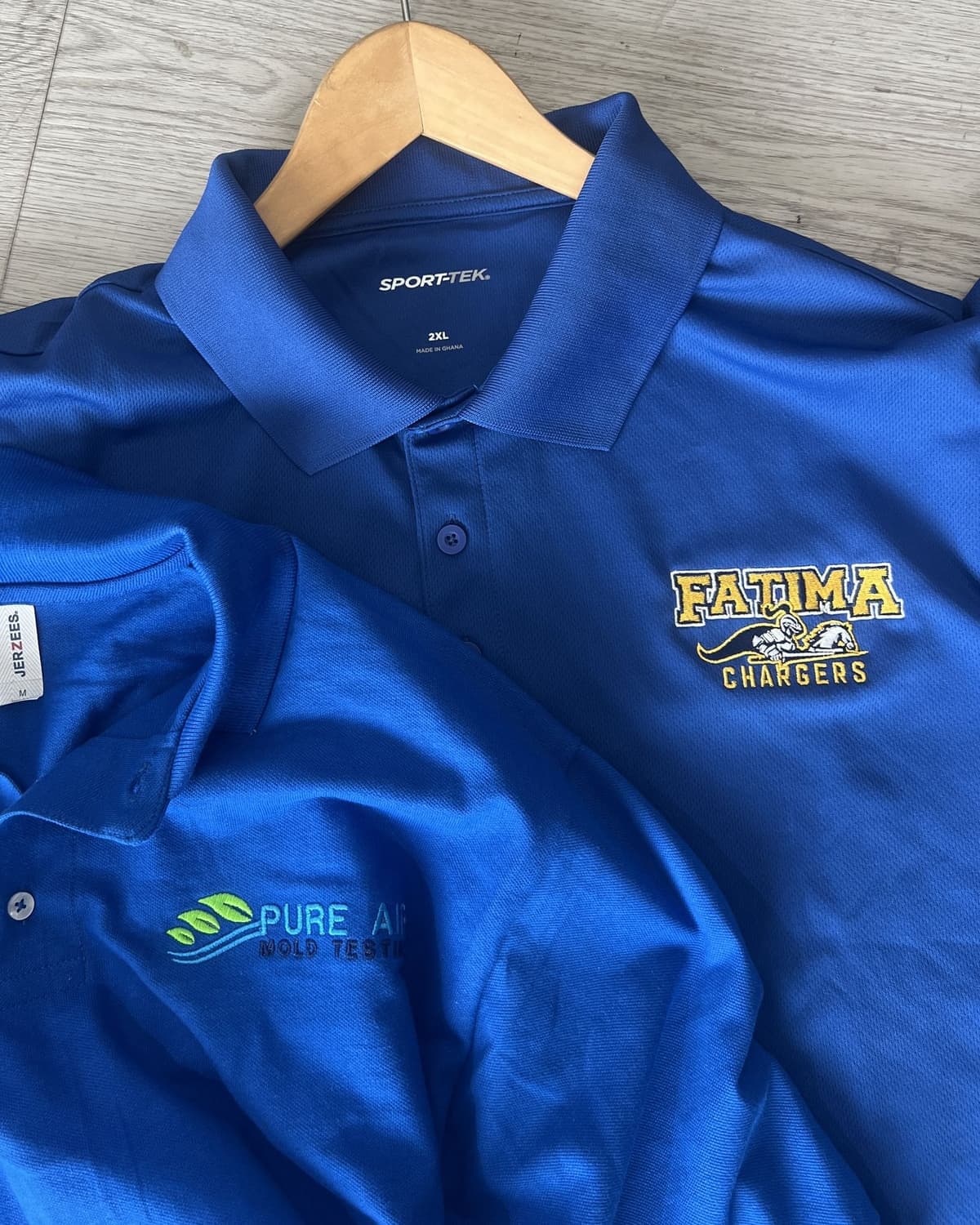
| Coaches and staff | Polo, quarter-zip or jacket | Embroidery on the chest |
| Fans and parents | Cotton or blend tee, hoodie | Screen print or DTG |
If you are not sure which fabric your league requires, ask your league office before you pick. Some leagues specify colors and number sizes, and it is cheaper to know that now than to reprint later.
Should the fabric be polyester or cotton?
For game jerseys, polyester or a poly blend is almost always the right call. It wicks sweat, dries fast and holds its shape after a season of washing. Cotton tees are fine for practice, warm-ups and fan gear, and they take ink easily.
Polyester does need a printer who knows how to handle it. Polyester fabric is dyed at high heat, and when it is reheated during printing, some of that dye can migrate into the ink and turn a white number pink or gray. We prevent that with low-bleed inks, a lower cure temperature and, on dark colors, a blocking base layer. If you want the details, our guide on screen printing on polyester without bleeding covers it, and printing on polyester and performance wear compares every method on synthetic fabric.
Which decoration method fits each part of the jersey?
Most team orders use more than one method on the same garment. The front logo, the back number and the player name each have a best fit.
Front logo or team name: screen printing or DTF
Screen printing is the workhorse for team logos. It is durable, it stays bright on dark fabric, and the per-piece price drops as the order grows. The screen printing minimum is 36 pieces per design, and the volume tier is set by the total pieces on the whole order, so a club ordering home and away sets together reaches a better tier than either set alone.
If a team has fewer than 36 players, or the logo is full color with gradients, a DTF transfer is usually the better route. DTF starts at 12 pieces, handles unlimited colors and bonds well to polyester.
Back numbers and names: heat transfer vinyl
Every player gets a different number and name, so a screen per player makes no sense. Vinyl is cut by our plotter one player at a time and heat pressed, which is why it is the standard for personalization. Heat transfer vinyl starts at 6 pieces and comes in standard team colors plus specialty finishes. Our HTV guide explains the material options and how to care for them.
Coach and staff gear: embroidery
Polos, quarter-zips and jackets for coaches look sharper stitched. Embroidery starts at 24 pieces, and a new logo carries a one-time digitizing fee to turn your artwork into a stitch file. Hats are 24 pieces whatever the decoration; see our custom hats page for styles.
If you are weighing these against each other for a whole program, how to choose a print method lays out all five side by side.
How do you build a roster that will not cause reprints?
The roster is where most team orders go wrong. A missing size, a duplicate number or a name typed two different ways means a garment printed wrong and a player without a jersey on game day. Build one spreadsheet and treat it as the single source of truth.
Use these columns:
| Column | Example | Why it matters |
|---|---|---|
| Player name as printed | RAMIREZ | Exact spelling and capitalization we press |
| Number | 7 | Check for duplicates before you send |
| Jersey size | YM | Youth and adult sizes are different blanks |
| Shorts or extra items | YM shorts | Keeps sets matched |
| Notes | No name, number only | Catches exceptions |
A few rules that save headaches:
- Collect sizes from a sample size run, not from guesses. Youth and adult cuts differ, and performance fits run smaller than cotton tees.
- Decide name style once: all caps or upper and lower case, first name or last name, and whether nicknames are allowed.
- Sort the sheet by number and scan for duplicates before you send it.
- Order a few extras in the most common sizes for late sign-ups. Adding two jerseys later is a separate small run.
Our answer page on ordering staff shirts and team uniforms has a printable checklist, and common problems ordering shirts for a group covers the mistakes we see most.
Where do numbers and names go, and how big?
Standard placements are a back number, a name bar across the upper back, and optionally a front chest number or a small sleeve number. Typical sizes many leagues use are a larger back number and a smaller front or sleeve number, but your league rules win, so check them first. Keep the name bar a consistent height across the roster; long last names get condensed to fit the same width rather than shrinking the letters.
Contrast matters more than style. A white number on navy reads from the bleachers. A gray number on silver does not. If you want a two-color number (a fill with an outline), tell us at the quote stage so it is priced correctly.
What happens after you request a quote?
Here is how a team order moves through our shop:
- Quote. Send the blank, the decoration plan, quantities by size and your in-hand date. You can price the front print yourself in our quote builder or switch to DTF pricing.
- Deposit. We take a 50% deposit to start, and the balance is due before pickup or shipping.
- Proof. You get a digital proof showing every placement and a sample name and number. Nothing prints until you approve it in writing.
- Production. Garments are ordered from our suppliers, logos are printed on our automatic presses, and names and numbers are cut and pressed player by player against your roster.
- Pickup or shipping. Pick up at 14130 Rosecrans Ave in Santa Fe Springs, Monday to Friday 8am to 4pm, or we ship by UPS or FedEx to a street address (we do not ship to PO boxes).
Standard turnaround is about 2-3 weeks after the artwork is approved and the deposit is paid, and it moves with our production schedule. Start early in the season. If your first game is close, call us with the date before you order; our rush page explains how we decide whether a tight date is possible, and what speeds up an order shows what you can do on your end.
How do you keep the cost down?
You can find current per-piece figures in our screen printing cost guide and DTF cost guide. The levers that move the number most:
- Fewer ink colors on the front logo. Each color in a screen print adds to the per-piece price.
- Combine designs on one order. The volume tier counts total pieces across every design.
- Reorder the same artwork. We keep your artwork on file, and a reorder of the same design skips the setup cost that is built into a first run.
- Keep the blank simple. A stock performance tee costs less than a premium two-button jersey and reads just as well on the field.
Frequently asked questions
Do you make cut-and-sew jerseys?
No. We do not make cut-and-sew jerseys or offer sublimation. We decorate ready-made jersey blanks and performance tees with screen printing, DTF and heat transfer vinyl. That covers the logo, names and numbers most teams need on solid or two-tone jerseys.
What is the minimum order for team jerseys?
It depends on the method. Screen printing starts at 36 pieces per design, DTF at 12, heat transfer vinyl at 6, and embroidery at 24. Small teams often print the logo with DTF and press vinyl names and numbers, which keeps the minimum low.
Can every player have a different name and number?
Yes. Names and numbers are cut in vinyl one player at a time and pressed against your roster spreadsheet, so each jersey is personalized. Send the roster sorted by number so we can check it for duplicates.
Will white ink turn pink on red polyester jerseys?
Not when it is printed correctly. Dye migration happens when polyester is overheated, so we use low-bleed ink, a lower cure temperature and a blocking base layer on dark or bright polyester colors.
Can you add metallic or specialty numbers?
Metallic ink and specialty vinyl finishes are available at an extra charge, which we quote on your estimate. Ask at the quote stage so the proof shows the finish you want.
Do you work with leagues and schools across Southern California?
Yes. We work with clubs, schools and rec leagues across Los Angeles and Orange County from our Santa Fe Springs shop. See our sports teams page or contact us with your roster and dates.